What Is Paint Correction? A Complete Guide for Car Owners
Everything Nampa car owners need to know about paint correction, including what it is, how the process works, and when your vehicle needs it.
Co-Founder & Lead Detailer · November 14, 2025
Searching for information on ‘What Is Paint Correction? A Complete Guide for Car Owners’ usually begins with a single frustrating moment. You look at your car in direct sunlight and notice a web of fine scratches, haze, or swirl marks covering the paint.
We see this realization happen all the time. Since Gemstar Car Detailing Nampa was established to set a new standard for excellence in the auto detailing industry, providing premium solutions for this cloudy appearance has been our priority.
Our detailing specialists consider this process the most transformative service available for your vehicle. Understanding the mechanics behind it helps you make an informed decision about long-term car care.
This guide breaks down the science of clear coats, the real causes of those scratches, and the exact steps needed to restore a mirror-like finish.
What Is Paint Correction? A Complete Guide for Car Owners
Paint correction is the process of permanently removing surface-level imperfections from your vehicle’s clear coat through machine polishing. Unlike wax or sealant, which fill in scratches temporarily to create an illusion of smooth paint, correction physically levels the clear coat to eliminate defects at their source.
We approach this step as a precise scientific process. Modern clear coats are remarkably thin, typically measuring just 35 to 50 microns thick.
To put that into perspective, a standard cigarette wrapper is roughly 25 microns thick. Our goal is to preserve as much of that factory protection as possible.
This mechanical leveling process involves three critical components:
- Machine Polishers: Devices that spin and oscillate to generate controlled friction.
- Abrasive Compounds: Liquid formulas containing microscopic aluminum oxide particles.
- Polishing Pads: Foam, microfiber, or wool attachments that dictate the cutting power.
We carefully monitor material removal, as a full multi-stage correction might shave off 6 to 10 microns. The result is a perfectly smooth, mirror-like finish that reflects light evenly without the haze and swirls that plagued the surface before.
Keep in mind that paint correction permanently removes clear coat material. While your vehicle’s clear coat is typically thick enough to handle multiple correction sessions over its lifetime, the process requires skilled professionals who understand how to achieve maximum results with minimal abrasion.
Types of Paint Imperfections
Swirl Marks
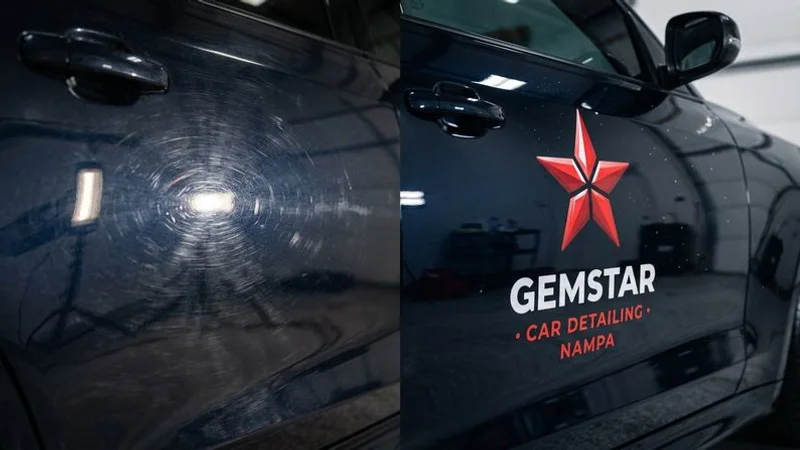
Swirl marks are the most common paint defect and appear as circular or semi-circular scratches in the clear coat. They are typically caused by improper washing techniques, automatic car washes with abrasive brushes, or wiping a dusty vehicle with a dry towel.
We constantly fix paint damaged by tunnel washes. Spinning nylon brushes at these automated washes act like sandpaper, trapping dirt from thousands of previous vehicles and grinding it into your finish.
In Nampa and the Treasure Valley, dry and dusty conditions mean swirl marks develop more quickly than in less arid environments. This local dust clings to wash mitts and automated brushes, accelerating the micro-scratching process.
Scratches
Light to moderate scratches that only penetrate the top layer of the clear coat can be removed through paint correction. Deeper scratches that reach the base coat or primer require touch-up paint and are beyond the scope of correction alone.
Our technicians use the fingernail test to gauge scratch severity. If your fingernail catches in the groove of the scratch, it has likely penetrated past the 35-micron clear coat layer.
These deeper defects cannot be polished out safely without compromising the paint system.
Oxidation
UV exposure causes paint oxidation over time, creating a chalky, faded appearance. Idaho’s high-altitude sunlight accelerates this oxidation, especially on vehicles parked outdoors.
We see the effects of this intense UV radiation on polyurethane and acrylic clear coats daily. The sun’s energy breaks down the chemical bonds in the paint, leaving the surface dull and vulnerable.
Single-stage paints found on older vehicles are particularly susceptible to this fading. Paint correction physically removes this dead, oxidized layer to reveal the fresh, vibrant paint underneath.
Water Spots
Hard water spots are mineral deposits left behind when water evaporates on your vehicle’s surface. The Treasure Valley’s water supply has significant mineral content, and these deposits can etch into your clear coat if left long enough.
Our local Nampa water supply can reach a hardness level of up to 7 grains per gallon, which equates to roughly 120 parts per million. These high concentrations of calcium and magnesium bake into the paint under the summer sun.
Light water spots can be polished out during a standard correction. Severe mineral etching, however, may leave permanent marks if the deposits eat entirely through the clear coat. Hazy, oxidized headlight lenses often accompany these issues, and our headlight restoration service can restore full clarity in the same appointment.
Holograms
Holograms appear as ghostly, three-dimensional reflections in the paint. They are actually micro-marring patterns left behind by rotary polishers in the hands of inexperienced detailers.
We prevent these buffer trails by using advanced Dual Action polishers. High-end tools like the Rupes BigFoot LHR15 feature a 15-millimeter orbit that spins and oscillates simultaneously.
Correcting existing holograms requires refined polishing techniques and soft finishing pads to level the surface properly. This dual movement disperses heat and eliminates the circular friction patterns that cause holograms.
Single-Stage vs Multi-Stage Correction
To make the best decision for your vehicle, you need to understand the difference between the two primary levels of correction.
Our shop evaluates the current condition of your clear coat to recommend the right approach. Both methods yield fantastic results, but they serve entirely different purposes.
| Feature | Single-Stage Correction | Multi-Stage Correction |
|---|---|---|
| Process | One polishing step with a medium compound | Two or more rounds using progressively finer compounds |
| Defect Removal | Removes 60% to 75% of light imperfections | Removes 90% or more of visible defects |
| Best For | Newer cars, light wash wear, budget-conscious enhancement | Heavy swirl marks, oxidation, deep scratches, show cars |
| Time Required | Typically completed in one day | Requires multiple days of intensive labor |
Single-Stage Correction
A single-stage correction uses one level of abrasive compound and one polishing step to address light to moderate defects. This process typically removes sixty to seventy-five percent of visible imperfections and is suitable for vehicles with minor swirl marks and light scratches.
We consider this the most popular option at GemStar for vehicles in generally good condition that just need refinement. It delivers a dramatic visual improvement in a single session and is highly cost-effective.
The single step enhances gloss and clarity without removing an excessive amount of clear coat.
Multi-Stage Correction
Multi-stage correction uses two or more rounds of polishing with progressively finer compounds and pads. The first stage uses a more aggressive compound, like Koch Chemie H9.02 or Meguiar’s M105, paired with a heavy cutting pad.
Our detailers rely on these heavy compounds to cut through deeper defects efficiently. Subsequent stages refine the surface with a finishing polish to create a flawless, mirror-like finish.
This intensive process removes ninety percent or more of visible imperfections. Multi-stage correction is recommended for vehicles with heavy swirl marks, moderate scratches, oxidation, or paint damage from improper detailing in the past.
It takes significantly more time and skill but delivers the highest level of finish quality.
The Paint Correction Process
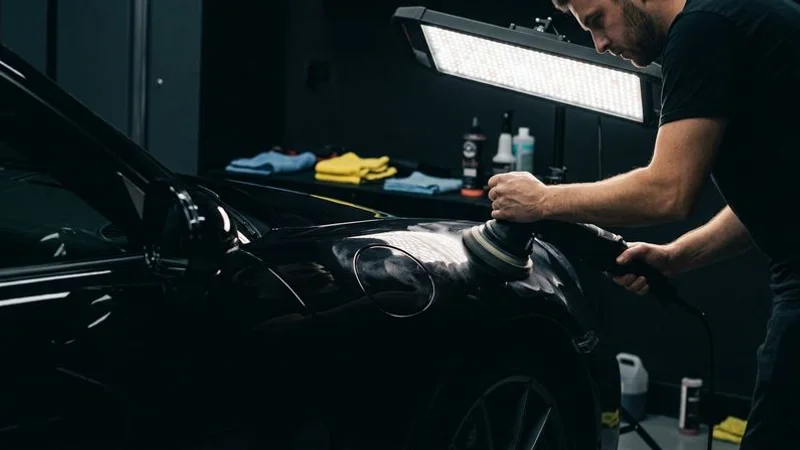
Here is exactly what happens during a professional paint correction at GemStar Car Detailing.
Step 1: Thorough Wash and Decontamination
We start the process with a complete hand wash and chemical decontamination. An iron remover dissolves embedded brake dust and industrial fallout from the panels.
Our detailers follow this with a clay bar treatment to remove bonded contaminants that washing alone cannot eliminate. This critical step ensures the polishing pad works directly on the clear coat rather than grinding surface dirt into the paint.
Step 2: Paint Depth Measurement
We use a digital paint depth gauge, such as a DeFelsko PosiTector, to measure the thickness of your clear coat on every panel. These devices read the paint thickness in precise microns to give us a clear map of the surface.
This measurement tells the technician exactly how much material is available for correction. Some vehicles, particularly those that have been repainted or heavily polished in the past, may have dangerously thin clear coat in certain areas.
Step 3: Test Spot
Before polishing the entire vehicle, a technician will tape off a small two-by-two-foot section on the hood or trunk.
We use this controlled area to determine the least aggressive combination of pad, compound, and machine speed required for your specific paint system. Different manufacturers use very different paint formulations.
What works perfectly on a soft Toyota clear coat may not even scratch the surface of a hard BMW finish.
Step 4: Systematic Polishing
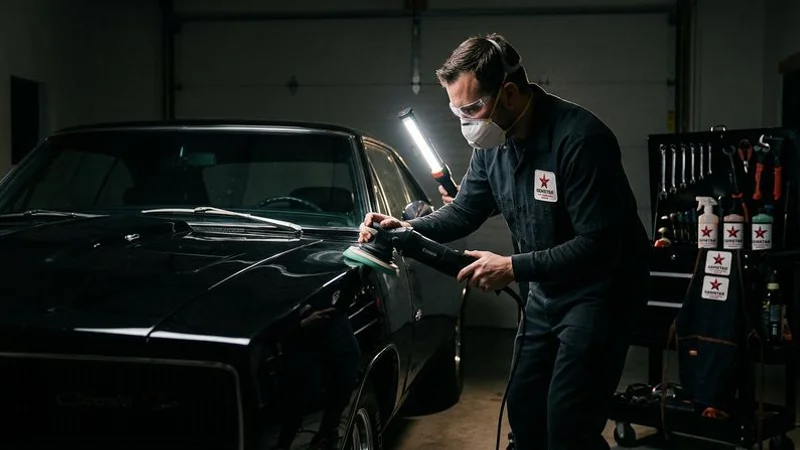
Working panel by panel under dedicated LED inspection lighting, our technicians methodically correct the paint. Modern 21-millimeter throw polishers allow the user to cover surface area efficiently without generating dangerous levels of heat.
We polish each section using the exact compound and pad combination identified during testing. A technician then wipes the panel clean with a microfiber towel and inspects it under multiple light angles to verify defect removal.
Step 5: Final Inspection and Protection
After completing the correction, the lead detailer inspects the entire vehicle under specialized lighting to ensure consistent, flawless results. The freshly corrected paint is now completely bare and highly vulnerable to the elements.
We strongly recommend protecting this new finish with a 9H ceramic coating or a premium sealant. For high-impact areas like the front bumper and hood, paint protection film (PPF) provides an additional physical barrier against rock chips. This specialized liquid polymer bonds with the clear coat and cures to a hardness level that resists micro-scratches on the Wolff-Wilborn pencil scale.
This final protective layer locks in the results and prevents new damage from occurring.
Should You Get Paint Correction?
Paint correction is worth considering if you notice swirl marks visible in direct sunlight, or if your paint looks dull and hazy despite being freshly washed. It is also an excellent choice if you are planning to sell or trade in your vehicle, or if you simply want your car to look its absolute best. Pairing correction with a thorough exterior car detailing ensures every surface is addressed.
We consider this service mandatory if you are preparing to invest in long-term protection. For Nampa drivers, paint correction before ceramic coating application is especially important.
A ceramic coating is completely transparent and will permanently lock in whatever condition the paint is currently in. Correcting the paint first ensures the coating protects and magnifies a flawless, brilliant surface.
Restore Your Paint to Perfection
If you have read this far into ‘What Is Paint Correction? A Complete Guide for Car Owners’, you already know the value of a pristine finish. GemStar Car Detailing offers professional paint correction services that bring back the showroom shine.
We serve Nampa, Meridian, Caldwell, and the entire Treasure Valley. Local drivers trust our shop to provide a customized evaluation for every vehicle.
Our team is ready to recommend the perfect restoration package for your specific paint system. Book your paint correction consultation online or call us at (208) 953-9102 to see what your paint can really look like.
Justin Finch
Co-Founder & Lead Detailer
Co-founder of Gemstar Car Detailing with 15+ years of detailing expertise.
Related Service
View Our Paint Correction Service →